
Different Types of Powder Bag Packing Machines and Their Applications
Not all industrial powders behave the same inside a hopper. Matching the feeding mechanism—impeller, twin screw, or net-weighing auger—to powder flowability prevents bridging, dust leakage, and weight drift.
1. Why Powder Flow Characteristics Dictate Machine Selection
Industrial powders vary widely in bulk density, moisture sensitivity, particle size, and cohesiveness. Free-flowing powders like dry sand or granular chemicals flow readily under gravity, while ultra-fine, cohesive powders like wall putty, hydrated lime, and titanium dioxide tend to bridge or flush.
Selecting the right powder bag packing machine means matching the feeder geometry to the powder behavior.
2. Impeller Valve Type Packers (Aerated & Free-Flowing Powders)
Impeller packers fluidize powder in a small chamber and fling it into a valve bag at high velocity. They are the workhorse for cement, fly ash, gypsum powder, and high-volume mineral powders where 300 to 1,050 bags/hour throughput is required.
- Primary applications: Cement, Fly Ash, Gypsum Powder, Limestone Powder.
- Bag weight: 20–50 kg valve bags.
- Key advantage: High speed and compact, dust-tight valve filling.
3. Twin Screw Packers (Cohesive & Non-Free-Flowing Powders)
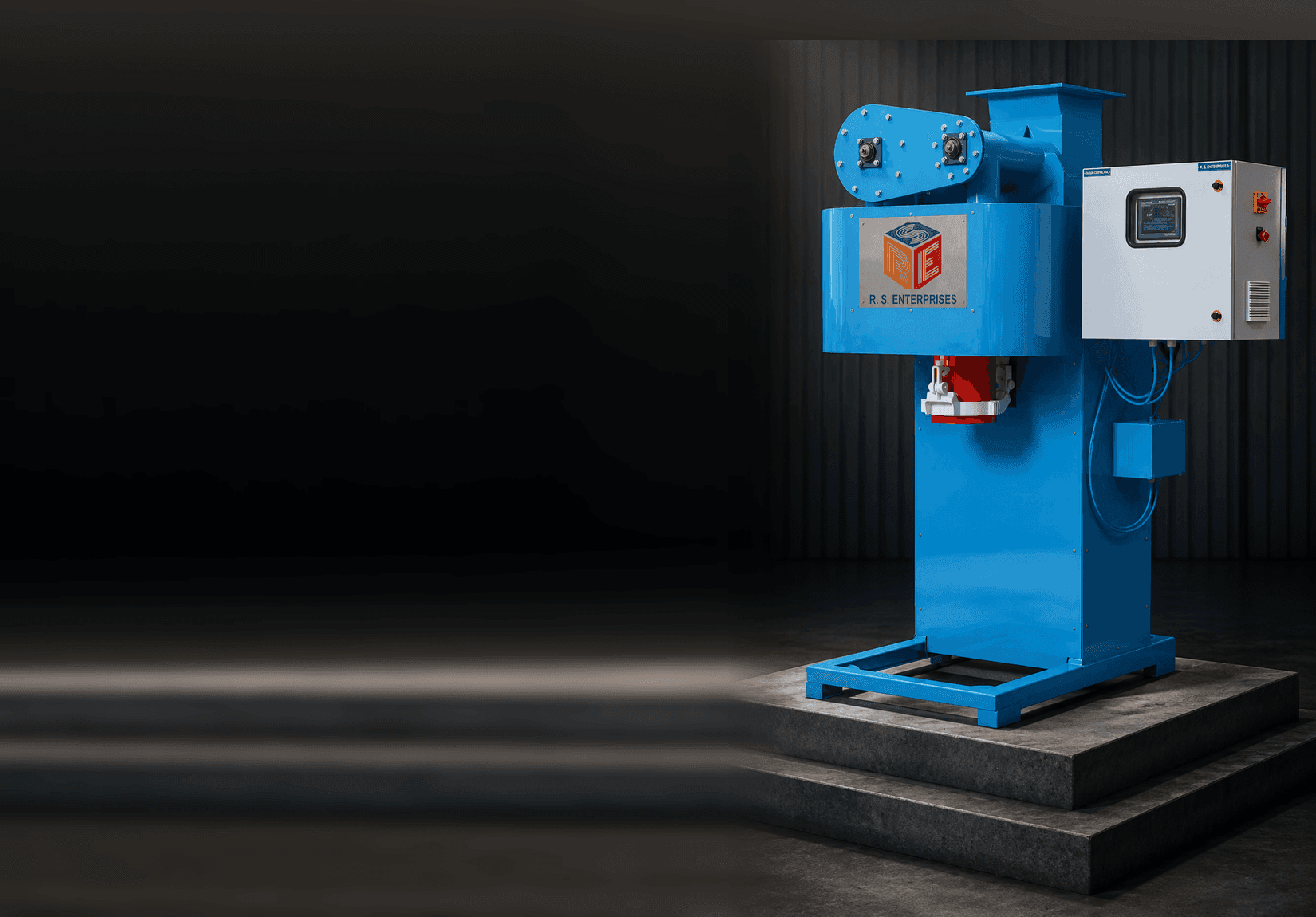
When powders contain polymers, cellulose ethers, or ultra-fine fillers—such as Wall Putty, Tile Adhesives, Skim Coats, and Specialty Chemical Powders—impellers can smear or aerate the mix excessively. A Single Head Twin Screw Packer (Model RSSHTSG) uses positive-displacement dual augers to meter material steadily into 20–50 kg bags at 140–240 bags/hour with ±50–75 gm accuracy.
- Primary applications: Wall Putty, Tile Adhesive, Drymix Mortar, Fine Chemical Powders.
- Power & Air: 3 Phase 415V AC @ 50 Hz; 10 CFM @ 100 PSI.
- Key advantage: Positive flow control without bridging or air-pocketing.
4. Open Mouth & Screw Net Bagging Machines (20–50 kg Bulk Lines)
For plants packing into open-mouth PP/HDPE bags, two proven architectures exist: gross-weighing Open Mouth Packers (RSIPOM-001 / RSIPOM-001.2, 240–600 BPH) where material is weighed directly inside the clamped bag, and Screw Net Bagging Machines (RSSNB-001 / RSSNB-001.2, 240–600 BPH for 20–40 kg bags) where an internal load-cell weigh hopper pre-weighs the batch before dumping into the bag.
| Machine Type | Target Materials | Output Range | Accuracy |
|---|---|---|---|
| Valve Type Packer | Cement, Fly Ash, Gypsum, Putty | 300 – 1,050 BPH | Electronic Load Cell |
| Twin Screw Packer (RSSHTSG) | Wall Putty, Tile Adhesive, Fine Chemicals | 140 – 240 BPH | ±50 – 75 gm |
| Open Mouth Packer | Ready Mix, Chemicals, Fertilizers | 240 – 600 BPH | ±0.5% Std Dev |
| Screw Net Bagging Machine | Free-flowing Powders, Minerals, Fertilizers | 240 – 600 BPH | ±50 – 75 gm |
Recommended R.S. Enterprises Machinery
Frequently Asked Questions
Which packing machine is best for wall putty and tile adhesive?
For cohesive, polymer-modified wall putty and tile adhesives, a Twin Screw Packer (RSSHTSG) or Valve Type Packer is preferred depending on formulation flowability and target BPH. For open-mouth bags, the RSIPOM-001 Open Mouth Packer is widely used.
Can one machine pack both cement and fly ash?
Yes. A Valve Type Packer is engineered to handle both cement and fly ash efficiently using electronic load-cell cutoff.
Need Engineering Guidance for Your Packing Line?
Share your material, bag weight, and target bags/hour with R.S. Enterprises engineers for a tailored machine recommendation.